Showing posts with label gardening. Show all posts

Sunday, April 27, 2008

What's Growing

Back when I was really into gardening, I'd take a tour of my garden everyday, to see what's blooming, what needs pruning and weeding, etc. My big passions were roses and bearded irises. I would spend hours online and buying books about roses, researching which ones to buy and where to plant, the way I do with knitting nowadays.
The other day I noticed that the rose on the mailbox was blooming, so I thought I'd do a little tour and post about it.
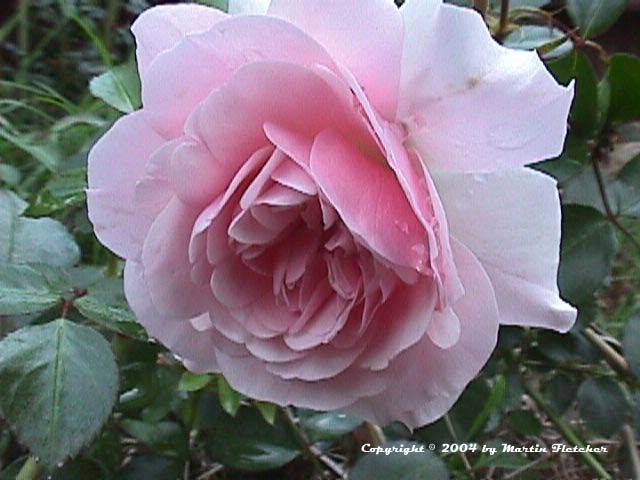
So starting at the mailbox, here is Reines des Violettes, the Queen of Violets, the first rose to bloom this year. In the background is the neighbor's house across the street and the red azaleas in her yard.The Reines de Violettes are fragrant, and fragile. If you try to cut off a bloom to bring into the house, it shatters. All the petals fall off. Not good for bouquets.

At the foot of the Reines de Violettes are these Dutch irises. In the background is a bare spot where an azalea used to be.

As we walk down the driveway, towards the house, we pass Henry Nevard, whose big red blooms should open in just a few days:

Henry's a big sprawling mess that I try to stake up, but he just won't behave. I'll have to truss him up against the chain link fence so when mowing around him won't put us at risk of having thorny canes smacking us.
Across the driveway from Henry are these white azaleas. I can't remember if they came with the house or if we bought them. Anyway, I love the white azaleas.

The beds in front of the house used to be thickly overgrown with spikey holly bushes and azaleas. Last year we cut them all pretty much down to 12 inches and they're just begining to grow back. Boy is it ugly, so no pictures.

Here's an example: the last of the tulips by the front door. The blooms have so many petals they look like peonies. They make great cutting flowers,

but not so pretty when left unattended.

At the end of the row in front are these red dianthus. The other stuff are weeds. I should really get out here and weed, but not today.
That's about it for the front yard.

The carport opens to the back of the house and connects to the patio. This is a view looking back at the patio. On the right is the last of the camellias, in pink. Camellias are pretty, but no fragrance. Next to it is the gardenia which will bloom in summer, perfuming the air. And to the left is a Japanese maple outgrowing its space.

In the background is the patio set where we have breakfast and read the paper on weekends, and eat dinner whenever the weather is nice.

Turning back around and heading toward the side garden, I pass a crape myrtle underplanted with irises and lilies of the valley. The purple iris is the first bearded iris of the year. In the background is grass and then ivy. The majority of the backyard is covered in ivy, so there's very little to mow. Thankfully.
And here's the side yard. This bed used to be a vegetable garden. But last year when we started renovating the front yard, I dug up the plants I wanted to save and put them here. The peony's blooming too. That's a surprise because I read that peonies hate being moved and don't always rebloom after being disturbed.

We'll just skip over the weed infested tomato bed and turn to the rose bed. It's up against the chainlink fence and the neighbor's blue pick-up truck is on the other side.

Here's Duchesse de Brabant, one of my favorites. It's just getting ready to bloom. The blooms are perfectly cupped and lightly fragrant but they shatter easily too.

It's a huge plant, about 5 feet tall and 6 feet wide. Pruning is one of my favorite gardening tasks and luckily roses take well to being trimmed, if done properly.

In the burgundy and white bucket to the left is a rose from the front yard. I think it's Bonica, but once it blooms I'm sure I'll remember.

This one below is Knockout, a very easy to grow rose. No fragrance but pretty cherry-red blooms.


That's it for what's in bloom now. This year I think I'm going to try to take better care of the garden. We're still in a drought so I don't know how much I can do. At least food gardens are exempt from the outdoor watering ban.

Husband and I've been talking about growing tomatoes and I might do some okra too. The only bed we can use we grew tomatoes in last year and we're supposed to rotate beds so the soil doesn't get depleted. But the other beds are holding plants from the front yard, so what to do, what to do...

Maybe nothing. Maybe we'll just wait out this year and see if the drought doesn't break next year.

Monday, August 6, 2007

No longer a gardener

Here in Georgia, we have been in a drought condition to one degree or another for about the last 5 years. We have watering restrictions, and in some parts of the state, homeowners can water only on Saturday or Sunday, and only between 10pm and 10am.

For the last 7 years, since we moved to our house, I had been a gardener, mainly into roses, hostas, irises, daylilies, all named varieties ordered from specialty growers. All the plants had their own labels that I made from wooden plaques. In the vegetable garden, we had tomatoes, okra, and peppers. I would tour the garden after work everyday, inspecting everything. Each time I planted or moved something, I would make a dated map showing the changes. I would hand dig new beds and add amendments to the hard, dense, Georgia red clay.

However, I have lost my interest. I admit I'm lazy and don't want to get up at 9am to water. Plus the mosquitoes are ferocious and the heat and humdity (despite the lack of rain, it's still humid) is unbearable in July and August and so slowly, my garden is dying, and I'm letting it.

The only things now that get care are the 4 tomato plants and potted plants and only because Husband does the watering. I mow the lawn, and that's all the "gardening" we do.

We had the 9 pine trees removed from our front lawn, leaving only the 2 dogwood trees. Prior to the tree removal, I dug up a lot of perennials and moved them to the vegetable garden and may the fittest survive. The first to die were the lilac and peony, neither of which do particularly well in hot weather anyway.

The front lawn is patchy. There are at least nine bare spots where the trees used to be, and then there's a quarter of the lawn that's just dirt. A few years ago, we used a lawn service to kill the weeds. Well, the weeds were what would grow and now that they're gone and the drought is here, the grass won't grow into that area and it's just eroding away. When I do mow the sparse tufts of grass within that area, huge dust clouds blow up.

We plan to have the front lawn torn up and sodded in the fall, when the rains return. I also had a landscape designer come out and give us a garden plan for the front yard. He recommended that we cut back the overgrown azaleas and holly bushes in the front yard to 6 inches, which we did. I'd like to dig up and remove the hollies entirely, but will wait for cooler weather to do so. I don't need to suffer heat stroke and sharp holly punctures.

Perhaps when the weather is better, my gardening interest will come back. But for now, I'm no longer calling myself a gardener.

Wednesday, May 30, 2007

Craft In America -- PBS series

Starting tonight, PBS will show a three part series about Craft in America http://www.pbs.org/craftinamerica/tv_series.html

I'm really looking forward to it because I love to make things with my hands, be it through gardening, pottery, knitting, and quilting, though quilting's on the back burner for some time now. I have a quilt top that I'm hand piecing. I call it my five year project and no matter what year it is, I think of it as year 2. Which means I have 3 more years in which to finish the project. Gotta love those movable deadlines.

It's summer and so begins art festival season. Over the Memorial Day weekend, Husband and I went to the Decatur Arts Festival and picked up three pieces: a metal fish, a woodblock print, and a painting. We had a great time.

This coming weekend is the Virginia-Highland festival and we'll be there too. My favorite local yarn shop, Knitch, is in Vi-Hi, so I may have to stop in.

Monday, May 14, 2007

Stash busting

This weekend I was not up for any heavy brain activity, such as comparing the knitting instructions for my sister's sweater to the sleeves themselves and then trying to figure out where I went wrong.

That's the problem with knitting -- every single stitch is your responsibility and there's no one to blame but you. In gardening, the plants grow on their own and sun, rain, soil composition, bugs, rabbits, voles, etc. all introduce elements of unpreditability. In pottery, the clay tells me what it wants to be, and then the glazes and kiln firings (done by other people), make each visit to the pottery studio a surprise. In gardening and pottery, things change without you making it happen.

Not so with knitting. Sweaters don't make themselves while you're gone and all mistakes are your own. Wouldn't it be great to have Mrs. Weasley's magical knitting needles, that knit on their own? We would be able to use up our yarn stash so much faster.

Speaking of stash-busting, I started 2 baby blankets this weekend and have decided to use up as much of my yarn as possible making baby blankets. You never know when a friend will announce a pregnancy and wouldn't it be nice to have something ready to give? This would be especially helpful when long-distance friends tell you with only weeks to go.

So this is what I'm working on:
1. I found a double crocheted 12 inch square of Mountain Colors Barefoot yarn in the Mystic Lake colorway that I made some time ago and one ball each of Knit Picks Essential Solid in burgundy, navy, and dark green. Clearly I was going to make something with this, so it will now be a baby blanket. It's sock weight yarn, so it'll take forever to finish. However, it's also thin and small, so it's my portable project.
2. Using Cascade Sierra in navy, light blue, pink, and white, held double, and crocheting stripes with a size J hook. I tried knitting, but Sierra is 80% cotton, 20% merino wool and 0% stretchable. So my first try, knitting, resulted in aching arms and elbows. Knitting is supposed to be fun, not painful. Now, I'm trying to use up the yarn as quickly as possible, just to get rid of it. What I do like is that holding one strand of navy, and one strand of either the light blue or pink results in a very pretty tweed effect. Will post pictures soon.

On the back burner: Husband's afghan and Sister's sweater, both in Cascade 220.